Love Spoken Here

Visiting Daddy in the early seventies, on weekends and during summertime, I remember how he loved to watch Lucha Libre. His favorite wrestler then was Rocky Johnson (the father of Dwayne “The Rock” Johnson). Also a die-hard Yankee fan, Daddy loved his baseball team.

“¿Vite? You see dat?” Daddy shouted and pointed to the TV, asking no one in particular. “Man, dat Mickey Mantle can hit dat ball sooo hard . . . !”

Daddy and my stepmother, Gloria, were raising my brother Ruben. Yes, I was a bit jealous. Although Daddy spoke both languages to me, I never became as fluent in Spanish as my brother had. I understood the language more than I could speak it.

Daddy enjoyed many hobbies. He knew his fruits and vegetables, having worked on his father’s land in his prime. He loved gardening and showing off his avocado and gandules (pigeon peas) plants that he had planted himself, just as much as he loved chewing and sucking the juice from raw sugar canes.

Although Gloria hardly spoke English, we managed to communicate well enough. She treated me like her own child, showering me with loud smooches and tight squeezes. When she talked to me in Spanish, I responded to her in English and my broken Spanish. In the mornings, she’d asked if I wanted “Con Fley” because she knew I liked cereal, and then asked if I wanted her to fix me a huevo frito, too. She was such a great cook; we all loved her comida. Seeing her work in the kitchen, preparing mouth-watering delicacies, was a common sight. Meals were her priority. She often cooked wearing rollers under a hairnet, sometimes in a floral house dress, and always chanclas on her feet.

Back then, feathered friends scurried about in the backyard, and a number of them were nesting on eggs. I liked feeding the ducks and watching them swim in the pond. Not so much with the chickens, though, I knew they were for consumption. But I couldn’t keep from watching in agony whenever Gloria ran after one, caught it, and then wrung the poor creature’s neck. It gave me the creeps. Then I’d stay clear of the messy job of plucking feathers. Gloria also chose whatever Daddy planted in the yard to complement any of her flavorful traditional entrées, whether her arroz con pollo (rice and chicken), arroz con gandules (rice and pigeon peas), or pernil (roasted pork). Each dish was first sautéed in sofrito (a mixture of bell peppers, garlic, onions, and capers blended into a paste) in a deep caldero. The aroma alone made your mouth water. Gloria served side dishes of fried sweet plantains, large Florida avocados, simmering red beans with new potatoes, and always with a big pot of yellow rice.

One Sunday, after a tasty meal of chicken stew, we drank café con leche, a strong espresso made with hot milk and sugar.

“Mary, did you like Mami’s pollo guisado?” Daddy asked, sipping from his cup.

“¡Si!” I answered, practicing my Spanish. “Muy bueno.”

“Oh, yeah? You wanna know somteen’?” Daddy’s eyes twinkled.

“¿Que?” I asked, blowing on my cafesito, too hot to drink.

“Dat’s no chicken you ate . . . dat was un pato.”

A duck? I stared at Daddy, and then at Gloria, then at the leftovers in the pot. I didn’t feel so good. My stomach felt queasy. I raced to the bathroom without a moment to spare when my entire lunch came up.

Gloria helped wipe my face in the bathroom and pleaded, “Ay, Marí. Perdóname.

I knew she felt terrible about what happened. But when I looked out the window, I couldn’t quit thinking about how I fed those cute, adorable ducks. And I had eaten one!

With no hard feelings toward anyone about the duck incident, I enjoyed being at Daddy’s house and forgetting my troubles back home with Mama. I noticed the way Gloria fussed and cleaned house; the same way she enjoyed cooking: fast, thoroughly, and con mucho gusto. She didn’t like dirt. She had every chair in the house, even the couch, covered with plastic! When it was time to clean the bathroom, she poured a bucket filled with soapy water on the floor, walls, and tub, scrubbing, mopping, and drying until everything was squeaky clean. She never relaxed until the evening when one of her novellas came on TV. Daddy and Gloria were affectionate and called each other pet names. Because Daddy’s skin was brown, Gloria called him, “Negro.” While many knew my stepmother as “Pita,” Daddy called her his “Mamita.”

Seeing their love in action made me smile. Although Gloria didn’t speak English, her hugs and warmth said more than the words of my own mother.

And she could cook.

12462_1273850935179_2169666_n(1)

Gloria making her famous pasteles.

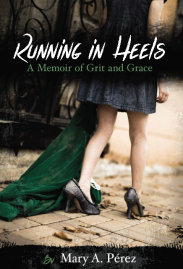
(Excerpt from Running in Heels – A Memoir of Grit and Grace ) © M.A. Perez 2013, All Rights Reserved. Note: Featured in La Respuesta online Magazine, Dec. 2013 Culture section

13 Comments

November 14, 2013 · 9:15 PM

This Language On Love


heart-300x235

So, in reading “The 5 Love Languages” by Gary Chapman, he describes in great detail how the concept of love can be very confusing. We love activities, objects, animals, nature, and people. We even fall in love with love. He points out that we use love to explain behavior. “‘I did it because I love her,’ says a man who is involved in an adulterous relationship. God calls it sin, but he calls it love. The wife of an alcoholic picks up the pieces after her husband’s latest episode. The psychologist calls it co-dependency, but she calls it love. The parent indulges all the child’s wishes. The family therapist calls it irresponsible parenthood, but the parent calls it love.”

Now I’m not by any means of the imagination, a psychologist, a professor, a clergywoman, or a counselor. I am just an ordinary woman. I’m a girlfriend, a daughter, a cousin, a sister, a wife, a mother, an aunt, and a grandmother. But like many, I think we all too often speak the wrong love language. I definitely have.

In my youth, I did some stupid things out of “love” for a guy. And because I loved him, I thought, surely he will come to my way of thinking. He would love me in return, enough to change his behavior and better himself. After all, hadn’t I bent over backward for him? Worshipped the ground he walked on? Become his doormat? In order to gain his undivided attention, I forgot who I was.

In my teens, I covered my husband’s transgressions. I hid his secret, sin, and shame. My way of thinking was: This is why I exist, right? That’s my job, isn’t it? His wish was my command. Barefoot, pregnant, and in the kitchen – if only I knew how to cook then. My smile hid the pain in my heart, as well as makeup hid the bruises on my face. I hid the grocery money and emptied the liquor bottles, refilling half with water, hoping he’d never notice. I’d called his boss to say he was sick in bed after another blackout episode. I told myself: I protect my interests. I do it all in the name of “love.”

I was tired. But because I loved my children, I eventually allowed them the freedom of choice. They started listening to the “hip” music their friends were listening to, and watched certain movies. Oh, yes, I knew they were old enough and wise enough not to repeat negative behaviors. Yes, I was inconsistent, worn-out, and haggard. I practiced tough love, church activities, rules, and schedules, but then lost the victory in my own personal life and tossed responsibility to the wind. I got lazy. It became every person for himself. I started doing my own thing. I felt defeated. Cold-hearted. Bitter. Since I had lost the battle as a wife, for a moment, I had also forgotten that there was still a war to fight for: motherhood.

That was many moons ago. And I’m happy to say, although far from perfect, I continue to strive to communicate this language in a healthier way.

Just some rambling thoughts today, as I reflect on Gary Chapman’s point of view about the language of love.

What are your thoughts?

© M.A. Perez 2013, All Rights Reserved

8 Comments

Filed under Gary Chapman, Love Language

She’s Not Tough, She’s Tenacious

At my grandparents’ home, weekends were our shopping days at Pantry Pride. Grandma pulled her two-wheel cart behind her, and Grandpa and I carried the rest of the groceries, chitchatting along the way.

“You know, young lady,” Grandpa said, “You’re going to have long legs when you grow up.”

“Are they going to be as long as yours, Grandpa?” I asked, trying to keep in stride.

“No, I don’t think so.”

“Will they be as long as Grandma’s?”

“Well, I’ll say there’s a good chance.”

“What about Mama’s?”

“Yep. I think they’re going to be longer than your mothers are.”

“Then I’ll be taller than her.” I skipped along thinking about it.

“Yes, yes, I think you’re right,” Grandpa chuckled.

We couldn’t walk at a fast pace on account of Grandma’s bad feet.

But one morning, we left for church later than usual. Grandma insisted that Grandpa and I run on ahead to stop the bus when we saw one. We took a shortcut along the sides of the railroad tracks. Trotting over the loose gravel became tricky, but we hurried on, determined to catch that bus.

“Papa,” cried a small voice. We didn’t hear that first call. The cry came again, followed by a moan. When we turned, we never imagined seeing Grandma lying facedown over pebbles and rocks. Grandpa moved with surprising agility and helped her sit up.

Grandma’s forehead bled from the fall. I cowered at the sight of so much blood. I felt sorry for her and helpless. Why couldn’t I have stayed close and given her my arm to hold onto?

Together, we walked back to the house. When we arrived, Grandma limped into the bathroom, and Grandpa helped her clean her face with a washcloth. To our surprise, she then insisted that we go back out.

“We are goin’ to church even if we are late,” she said.

“Aren’t you going to at least change your blouse?” Grandpa asked.

“¡No señor!” Grandma said with finality. “I’m goin’ just as I am.”

(Excerpt from Running in Heels – A Memoir of Grit and Grace )

© M.A. Perez 2013, All Rights Reserved

3 Comments

Filed under family, Tenacious

This Lesson About Life

The lesson about life with its many twists and turns has been an amazing journey. I often think: What legacy will I leave behind when I’m finished with this race? What I do today, will it count for something tomorrow? When I’m long gone, will I merely be a faded memory or a burn in someone’s heart? Will my deeds be forgotten? Lost? Or buried?

I’ve read about some incredible women. These women did not allow age, status, limitations, or even imprisonment to deter them from their destiny. As fleeting as it is, they knew their self-worth and value in this life. Women like Mother Teresa gave 50 years of service to the poor, the sick, the orphans, and the dying in Calcutta, India. Women like Corrie ten Boom, who spent 10 months in a concentration camp at the age of 53, began a worldwide ministry that took her into more than 60 countries in the next 33 years of her life. I didn’t know them personally, but they were admirable, inspirational women.

They made a difference.

Many endearing women have entered my life, not only as friends, but also as mothers, sisters, grandmothers, and mentors. While each embodies unique gifting, each holds a special place in my heart.

One such individual is Elizabeth. She loves people. She is full of life, charm, and wit. She believes in having a 90% attitude and 10% circumstance. She loves to laugh, crack a joke, watch the Kentucky Derby, share about her travels around the world, read anything that takes her miles away, watch The Lawrence Welk Show, and go right on dancing if only she could.

I’ve known her for over thirty years, but within the past couple of years, she has been unable to use her walker. She doesn’t walk anymore. Yet her mind is still intact; her wits still sharp, as well as her tongue. My husband, daughter, and I take care of her. While we attend to her daily needs, she is teaching us about life. Oh, and did I mention a horse and buggy rushed her to the hospital, and that she was one year old during the Titanic?

That’s right, Elizabeth was born in 1911. You do the math.

To know Elizabeth is to have your life enriched.

As I age, may I emulate her love and passion for living.

  555311_10201955181788991_748998477_n

© M.A. Perez 2013, All Rights Reserved

22 Comments

October 24, 2013 · 10:26 PM

This Thing Called Tears

I consider myself a tough cookie. After all, aren’t I a survivor? I’ve lived through more than my share—broken home by age three, poverty, hunger, homelessness, neglect, loss of a sibling at nine, violence, abuse in its many forms, and more than a few close calls with death.

BUT God!

However, there is a softer side to me as well. This thing called tears. Yes, a family member has even called me sentimental.

I cry over a lot of things. Losing a pet, or even an insect. A newborn’s first cry. A book, a song, a dance, a wedding, a movie. Sometimes even opening a gift or saying goodbye catches me off guard.
Mountains, rainbows, oceans, hummingbirds… they move me more than I care to admit. And when my grandchild called me “Mimi” for the first time, I completely lost it.

And yes, sometimes I cry when I’m hurt, scared, tired, or angry.

I don’t always want people to see that side of me. I’m supposed to be tough. Not weak. Remember?

Now I’m not much of a horse person, but I know enough to know that a horse is all grace and strength—every muscle, tendon, and ligament working together to carry a rider at full speed. Yet even that kind of power is guided by a bit in its mouth, moving where it is led.

When I read about Moses, I’m struck that he was described as the meekest man on earth. And when I read about Jesus, I see power beyond measure, yet fully restrained. His meekness was never weakness.

So, I say: It’s okay to let our guard down at times and reveal our softer, sensitive selves. It doesn’t mean we’re a softy, a weakling, or a pushover. Power under control means self-control, and that is a virtue. After all, we are human with God-given emotions. Besides, God bottles our tears.

And because God loves us so much, sometimes I wonder if God cries too.

© M.A. Perez 2013, All Rights Reserved

tears

23 Comments

Filed under musing, virtues

She’s My Mama

Mama lives alone. She enjoys a contented life. She loves playing Bingo and the group outings on the Metro-Lift with Charles, her traveling companion. They attend church together. Mama has a provider who cleans, cooks, and provides assistance. I have reached a point where I can let go and allow her to live her own life. While Mama has learned not to rely upon me as heavily as before, she knows I will be there whenever needed.

This past week, we celebrated Mama’s 79th birthday at an Italian restaurant. She doesn’t like her pictures taken and has always been shy in front of the camera. Rest assured, she enjoyed her day, having no problem dining out and opening gifts.

mom

Initially, when I shared with Mama that I was writing my memoirs, she laughed and squealed, “Mary, what kind of book is that going to be?”

I chuckled, answering, “Stranger than fiction, of course.”

Later, with a more serious tone, Mama asked, “So, you’re going to blame me for everything that has happened?”

While our relationship and communication continue to require work, I assured her that I don’t blame her for all the bad.

Let me be clear: I do not hate Mama. I NEVER hated Mama. I hated her behavior. I resented everything and everyone that took her away from me as a child! Though my mind may still remember the neglect, I realize that nothing I did or did not do could have changed her then. Or now. I can only change myself and aim to become better.

Several years ago, someone recommended Irregular People, by Joyce Landorf, which helped me tremendously. Nearly everyone has a difficult or “irregular” person in his or her life. They can be emotionally tone-deaf and not really hear you. They may be emotionally blind and not see you. They may even have a speech impediment and struggle to express themselves adequately to you. You cannot please that person; you cannot change them, no matter how much you wish to.

I can be at peace and know that the way Mama—or anyone else—chooses to live their lives isn’t a reflection of me.

Yes, writing is therapeutic, but if I can show just one person that they are not alone in their struggles, then I have done something good. Through it all, one can have purpose and meaning and overcome.

In the dynamic of things, I felt Mama did her best.

As we all try to do.

closeup

© M.A. Perez 2013, All Rights Reserved

10 Comments

Filed under Mama, parenting

“Mrs. C”

We affectionately call her Mrs. C.

In her sixties, with remarkable zeal, she carried a charismatic and gregarious personality. She was a Bible teacher, an author, a missionary, a powerhouse, and a woman of great faith. She exuded genuine friendship in a Godly persona and took me under her wings. She held many prayer meetings in her home and often prostrated herself on the floor, face down, interceding for others. She became my lifesaver, my spiritual mother. Throughout the years, I frequently relied on her for spiritual guidance and much-needed counsel.

On one dreary afternoon, the sky grew overcast along with my hope and faith. Suffering from battle fatigue, I sat in Mrs. C’s den. I told her I was sick and tired of being sick and tired.

“I can’t take it anymore,” I confessed, wringing my hands.

Patiently, unassuming, and non-judgmental, Mrs. C handed me a tissue and gave me time to release the dread and pain in my heart.

“I’ve tried everything. Done all I know to do. Yet nothing seems good enough.”

“Has he stopped hitting you?”

I sighed, much relieved that he had. “Oh, yes.”

“Mary Ann, in his own way, you know he loves you,” she began, “but you have become ‘weary in well-doing.’ In your mind’s eye, you’ve conceded it’s not worth it.”

She honed in on my sentiments. I hung my head in shame.

“You know,” she insisted, “it is worth it all.”

At that moment, I wished I were stronger and smarter, and Mrs. C wasn’t so wise and read me so well. “But shouldn’t this be a two-way street?” I suggested.

“Are you and the kids better off without him?”

I figured she knew the answer before I did. “We . . . we have nowhere else to go.”

“Are you better off without him?” she repeated, handing me the tissue box.

“Money is tight. I can’t afford to do anything else.”

“Are you better off without him?”

No,” I whispered and wiped my nose.

I felt weak and inadequate as a Christian wife, struggling to maintain a measure of peace and sanity in my household with four children and tending to a man struggling with his demons.

“Then, go home and be the best wife and mother you know how to be,” she said.

Sometimes, it’s easier to talk the talk than to walk the walk.

“But first,” she added, “I want to pray for you.”

That woman knew how to enter the Throne Room of God in her prayers. Electricity surged through my entire body when she touched me while praying. Before I left, she handed me her book, Wives, Unequally Yoked. I figured reading couldn’t hurt, plus the title intrigued me. I’d already devoured The Total Woman, by Marabel Morgan. The pages were worn and underlined with a yellow marker, much like my own Bible.

“PRAY HARDEST WHEN IT’S HARDEST TO PRAY”

I didn’t leave Mrs. C’s company the same way I arrived. Resolved in my heart not to become bitter, I determined to be better and left strengthened, with a made-up mind.

Mrs. C suggested that I study a passage in the Bible that read: “In the same way, you wives, be submissive to your own husbands so that even if any of them are disobedient to the Word, they may be won without a word by the behavior of their wives, as they observe your chaste and respectful behavior.”

I had to admit this wasn’t easy. I’d used my tongue as a weapon more times than I cared to count, and didn’t know if I could keep my mouth shut. But with renewed determination, I worked on dropping the holier-than-thou attitude and praying for my husband more. This time, I prayed–not that my life might become easier–but that he might become whole: physically, spiritually, and emotionally.

Note: Has anyone outside of your family meant the world to you? Made an impact? Enriched your life?

Throughout the years, many have come into my life, for which I am eternally grateful. Mrs. C recently celebrated her 87th birthday. Although not as active as once before, Mrs. C has touched and helped countless lives that are still going strong today. Because of her, many have realized their true potential and reached their purpose.

Michael C. Dudash

Painting by Michael C. Dudash

© M.A. Perez 2013, All Rights Reserved

3 Comments

October 6, 2013 · 12:51 PM

Nothing Lasts Forever …

One rare but cherished winter night, my stepdad unexpectedly came home with a surprise and tossed a brown sack onto my lap. Puzzled about what could be inside, I hesitated to open it. The bag moved. I jumped. I glanced at Mama, and she nodded her head to continue. The bag moved again. I inched forward and peered in. Then the eyes of a black puppy looked back at me. Holding my breath, I lifted her out. Her long, wet tongue washed my face and made me giggle. I loved her and named her Blackie.

She followed me around. She kept me company. At night, she slept on my neck, keeping me warm. Once, when my parents yelled at me, she growled. I laughed inside and hugged her. I knew she loved me, too.

My joy turned to heartbreak the day she disappeared. I searched everywhere for her.

“Mama, have you seen my puppy?”

“We can’t keep her.”

“Mama, why? Why can’t we?”

“Because Blackie’s full of fleas.”

“I’ll give her a bath.”

“We can’t feed her.”

“She can eat my food,” I sobbed.

“That’s enough, Mary.”

Again, I asked. “But why, Mama?”

“Nothing lasts forever,” she said, still reading her magazine.

I’d have kept Blackie forever.

(An excerpt from Running in Heels – A Memoir of Grit and Grace – Chapter One)

© M.A. Perez 2013, All Rights Reserved

Note: I recall many clichés told to me as a kid. One that pops into mind is: Easy come, easy go. How about you? Do you remember things said to you when you were young that maybe got under your skin?

5 Comments

Filed under Memoir, pet

Her Little Green Dress

I held her close and cradled her head.

Soft, velvety cheeks. A round, rosy nose. Dark hair like mine, but curly. Eyes, blue, that sparkled like the ocean I’d seen in storybooks. I kissed her sweet-smelling face. Her soft, pudgy hand with tiny fingers curled inside mine. My new baby sister, Anna, melted my heart. I won’t be alone anymore, and she won’t be alone. I caressed her face and whispered, “I’ll stay by your side for always.”

Soon after being left with the responsibility of caring for her, I became my sister’s substitute momma. I loved her and took care of her as best a seven-year-old could.

I didn’t know what to do the day we ran out of baby formula and diapers. I waited until Anna stopped fussing and fell asleep in her carriage (we didn’t have a crib for her). Then I ran to the corner to a hole-in-the-wall, where I knew my mama and stepdad, Jimmy, were.

A blinking neon beer sign over the door clattered when I pushed it open. Dimmed lights hung from the ceiling. The hazy, smoke-filled room from cigarettes made my eyes water and my nose run. Loud music played on the jukebox. Boisterous men and women engaged in a game of shuffleboard; others threw darts. Still others, sloshing their drinks, perched themselves on barstools, carrying on like screaming peacocks.

“Whataya have?” yelled the bartender. I jumped at his voice, thinking he meant me.

“Hey, Charlie, whose girl is this?” a man grinning with a silver tooth asked.

“She’s Ruthie’s little girl,” Charlie answered, pointing in the direction where Mama sat.

The all-too-familiar rowdy voices of my parents, cursing at each other, reached my ears. I ran toward them. When I told Mama about Anna, she and Jimmy started arguing over money.

I waited, feeling forgotten, wishing Mama would hurry and come home with me. Then someone handed me a nickel to play the jukebox. I remembered my manners, thanked him, put my coin in the slot, and punched in the numbers to Spanish Eyes.

At last, Jimmy gave Mama what she wanted, but he remained roosting on his stool.

When we returned home, we never imagined that someone had called the law. They met us at our front door, holding my naked sister, wrapped in a soiled blanket.

“Is this your baby?” an officer demanded of Mama.

“Yes . . . yes . . .” her voice cracked.

“Ma’am, have you been drinking?” The other cop asked in a gruff voice. But before Mama answered, he stepped forward and said, “Turn around and put your hands behind your back. You’re under arrest for child abandonment.”

“Ma—?” I choked back the burn in my throat.

To my horror, the police officer put handcuffs on Mama and started telling her something about “remaining silent.”

Why can’t she talk? “Tell him, Mama,” I insisted and started to cry. I turned to the officer to explain, “We were going to buy milk and diapers for my sister . . .”

He didn’t hear me and shoved Mama in his police car. She looked at me; her face glistened with tears running down as they drove away.

“Where . . . is he taking my mama?” I choked, sobbing. I hovered close to Anna, ready to grab my sister, to run fast and hide before he took us to jail, too. In my confusion, I don’t recall what he said except that they were there to help and take us to protective custody. I protect my sister, I thought. I begged him not to separate us.

The cop drove us to a children’s hospital for routine examination and to remain there for safekeeping until a suitable family member claimed us.

(TWO YEARS LATER):

A siren blared nearby.

I turned to Mama and asked, “Where’s Anna?”

“That drunken louse came by to bother me again,” she huffed.

“Mama, you said you were finished with him.”

She swatted the air with her hand as if shooing a mosquito. “He insisted on taking his little girl for a short walk.”

A neighbor came running and whispered breathlessly to Mama. Right then, a police car pulled up, its radio static coming from within. An officer climbed out of his cruiser and walked toward them. Within seconds, someone let out a cry, and her voice sounded familiar. In shock, I witnessed my hysterical Mama sprint down the street. I stifled a scream. My heart pounded in my chest. I didn’t know what happened, where she was going, or why.

I don’t remember who drove us to the hospital. But once we arrived, a nurse pointed down the hall to where they cared for her. Except I couldn’t go to see her because I was too young.

I had to see her.

My legs trembled as I crept to her room and peered through the glass-paned door on my tiptoes. First, I saw a blinking monitor. Then I saw her—my baby sister—with soiled feet, still in her favorite, green denim dress, tattered and torn. On her back, Anna lay motionless, her curly brown hair matted with blood. Her face was bruised and swollen; her baby blues closed tight.

I felt light-headed as I slumped on the floor, pulling my knees to my chest, crying.

That night, we returned to the scene of the accident. I will never forget the puddles of congealed blood that saturated the street. I wanted to scream. To run. To hide. Blood-soaked rags from my sister littered the pavement.

Others offered shallow words of comfort. “Don’t cry,” they said. “Think positive thoughts,” they chimed. “The doctors are doing everything they can for your little sister.” But all I heard was my sister’s blood calling out to me, along with my broken promises: “I’ll protect you,” pounding in my head.

A couple of days after, I awakened to the sound of rain and a car door slamming. I peeped out my window and saw a taxi pulling away from the curb. My grandparents, grim-faced and eyes downcast, walked to our doorstep. A shiver ran down my spine, and a horrible dread washed over me. I threw myself on the bed, a knot lodged in my throat. Then I heard my mother’s wails. I curled up in a ball and covered my ears. God, it hurts! I cried. Make the pain go away.

My sister was gone. Forever. A month earlier, we celebrated her birthday. She had just turned two. I was nine but felt ancient. Empty. And heavy. The weight of the world on my thin shoulders.

Like a fuzzy videotape, fragments of blurred images and sounds played across my mind: Anna’s dancing blue eyes, laughter like the morning sun, vibrant flowers . . . Mama’s primal screams, hushed voices, muffled sobs.

At the funeral, I held my breath and willed my feet toward the small white casket. Grandma squeezed my hand. I took my finger and stroked my sister’s face, which reminded me of a doll made of plastic, stiff and cold to the touch. Heavy makeup could not conceal her bruises. Her grotesque head was cradled by a bonnet that was much too small. She wore a new green dress, cleaned and pressed, with no stains. Or blood.

I glanced up at Grandma. “Your sister’s in a better place now,” she choked. Then I placed a small cross under Anna’s tiny, rigid hands. My tears blinded me.

“. . . If I should die before I wake, I pray thee, Lord, my soul to take.”

Why, God? Why? Why did you have to take her?

Anna, I’ll love you for always.

Mama sat by the farthest wall away from people, away from the coffin. Her eyes were swollen and red. She didn’t seem so tough then. I went to sit by her.

The year 1968 was a year of deaths that shocked and changed history. But the girl in her little green dress was the one who mattered to me. She was my sister. My best friend. She lay in an unmarked grave.

(FOUR DECADES LATER – a flight to Miami):

The area was a lowly, plain grass field devoid of even a tombstone for my sister. No headrest. No name was written. Or flowers anywhere. Just hard soil. Plenty of weeds. I crumbled to my knees and sobbed.

Anna, I’m sorry. Sorry, I couldn’t do better. Sorry, I failed you. I promised, “for always,” yet fell so short. If I could hold you now, I would.

Closer.

Tighter.

Never let you go.

If only I’d done more, fought more, loved more. I see myself holding you. Holding you so tight, that time stands still. Darkness cannot swallow us. Pain cannot touch us. Death cannot rip you from my arms. Sorrow cannot engulf us.

God, it still hurts . . . bring healing.

Before I left the cemetery, my brother and I purchased a tombstone and had it engraved.

Por fin,” I imagined my grandma’s words.

Yes, Grandma, finally,” I whispered. “At last, and long overdue.”

In memory of my sister, Anna R. Molloy, who was struck down by a hit-and-run driver.

© M.A. Perez 2013, All Rights Reserved

37 Comments

September 21, 2013 · 5:50 PM

Remembering 9/11

I imagine most of us remember where we were or what we were doing on September 11th, 2001.

Around 7:50 a.m. while driving to work, the morning newscast blared over the radio that a plane had crashed into the World Trade Center in New York. As soon as I arrived at the office, I ran in and flicked on the TV to see the live broadcast of a massive hole in one of the towers caused by the plane’s impact minutes before. As fellow co-workers gathered in the small conference room, we couldn’t peel our eyes away from the screen. Black smoke billowed out of the building and was soon engulfed by flames.

We heard what our ears didn’t want to hear and continued to see images that will forever be etched in our minds. My insides plummeted as I saw a second plane hit the other tower. Buildings collapsed minutes later, and we all gasped in horror, knowing that hundreds of thousands of people lost their lives.

My heart went out to those who lost loved ones on that fatal day.

That same evening, President Bush spoke powerful words: “Freedom itself was attacked this morning by a faceless coward, and freedom will be defended.”

Freedom isn’t free, I thought, and freedom is worth any cost.

May our presidents keep us free from terror, both at home and abroad.
May Almighty God keep us safe and secure in our hearts and in our homes.

6 Comments

Filed under Sept. 11