Tag Archives: co-dependency

Understanding Co-dependency: A Path to Healing

Co-dependent. Such a complex word.

Have you ever looked back and realized how wrong you were while trying so hard to do the right thing?

My former husband was deeply in love with himself. His needs, desires, and wants came before everything else. I believed that if I made him happy—if I did everything he wanted—peace would follow. I thought agreeing with every opinion, fulfilling every wish, was the price of sanity. I gave in to keep the peace, hoping that surrender would soften him. Maybe then he would be tender. Maybe then he would love me. Surely, I thought, he would choose me over his endless need for others: his hobbies, his friends, his conquests.

But I was only deceiving myself.

I received no respect, and the mistreatment never stopped. Quietly, resentment grew, yet not enough for me to change my behavior. By tolerating the offenses, I was granting permission for them to continue. It felt as though I had signed away my rights, and my life. Slowly, I was disappearing. I felt unloved and undone, stripped of self-esteem and self-worth. I was lonelier with him than without him. Still, I wanted him. I craved his approval and acceptance. I lived in fear of him and equally in fear of losing him.

We often believe peace will come if we can control our environment. In truth, serenity is usually nowhere near that path. What we gain instead is a fragile, false peace, one that never lasts and always comes at a cost.

I’m not a psychologist or a psychiatrist, but I’ve come to understand that there is another side to this spectrum. Sometimes, a person loves so deeply that they give everything of themselves. Over time, that love can become smothering, stunting the other person’s ability to care for themselves. The loved one becomes dependent emotionally, psychologically, incapable of growing, make sound decisions, or mature. Trauma lingers, and emotional immaturity takes root.

I saw this pattern with my mother. From childhood, Mama was introverted and painfully shy. Grandma loved her fiercely and felt sorry for her, often overcompensating by doing everything for her. As a result, Mama grew accustomed to others taking care of her. When I was young, I stepped into that role myself. I tried to protect her in every way I could. Often, my help wasn’t needed or asked for. She, in turn, leaned on her significant others to meet that same need.

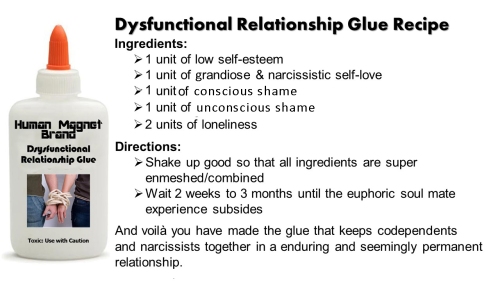
Co-dependency is a vicious cycle. Left unaddressed, it festers like a chronic wound. In relationships unwilling to heal, both people struggle with low self-worth. Boundaries are weak or nonexistent. Control and manipulation replace trust, and love becomes entangled with fear.

Have you ever realized how wrong you were in trying to do right?

dysfunctional-Glue

Here are some examples of what it means to be co-dependent:

• The need to be needed
• People pleasing
• Trying to control others (aggressively or passively)
• Focusing on helping others before working on your own issues
• Being consumed with other people’s problems
• Rescuing
• Self-doubt
• Unclear boundaries in friendships and relationships
• The tendency to date (or marry) alcoholics or addicts
• Perfectionism
• Workaholism (or always being busy)
• Exhaustion

Let’s break the cycle!

Your turn. What does co-dependency mean to you?

8 Comments

Filed under Behavior, Co-dependent, Relationships

Damaged Goods

Definition of damaged goods: inadequate or impaired. Products that are broken, cracked, or scratched. A person considered no longer desirable or valuable because of something that has happened—someone whose reputation is damaged.

Are you damaged goods? Do you feel unworthy?

You don’t have to remain that way, regardless of your past or your present.

Was that ever me?

You betcha!

Read on…

Hollow. Pure loneliness. Dark, like a bottomless pit. Ripping in my chest. Piercing my heart. Again, he stays out all night. Overcome by torment. Abandonment accompanies me. Consumed with depression, isolation wraps itself around me. My mind races with wild imaginations of where he has gone, what he is doing, and with whom.

Instead of going to bed to sleep, I am wearing a hole in the couch. Every time a car approaches, I spring like a jack-in-the-box, peeking out the window, hoping he has returned. With every disappointment, my stomach turns into knots. My own sobs mock me until I cry myself to semi-consciousness. Hideous lies will follow after he returns and add to my anguish and emotional decline. 

Broken. Flawed. Undone.

That was me back then, living with a cheating husband. His words, like rubbing alcohol poured over fresh wounds, stung!

There were no quick fixes. No bandages for emotional wounds. I sank deeper and deeper into a dark abyss, convinced I was beyond repair. For years, that was my reality.

But I know now, it didn’t have to be.

So what was the problem?

I was overwhelmed by abuse—physical, verbal, and emotional. My self-esteem was nonexistent. My sense of worth? Gone.

I believed the lies about who I was and what I deserved. I convinced myself this was just my life, my portion, my fate. I had seen the cycle before in my own family, yet somehow I couldn’t recognize it in myself.

“I made him mad again… maybe I deserved it.”

That’s what I told myself.

That’s what co-dependency sounds like.


How do you see yourself?

Have you been lied to? Torn down? Made to feel small and insignificant?
Do you feel like you’re drowning, gasping for air but never quite reaching the surface?

Maybe you’ve been trying so hard to please someone else that you’ve lost yourself in the process, compromising your values, your peace, your health, your identity.

Enough.

Do not allow someone else’s brokenness to rob you of your joy or harden your heart.

You are worthy.
You are valuable.
You matter.

There is nothing wrong with being fragile, but be like fine china: delicate, yet precious and worth protecting.

You are not damaged goods.
You are not disposable.
You are not a forgotten memory.

Do not become someone’s victim because you believed their lies.

I am living proof: God does not discard what He intends to restore.


Get up.

Rediscover yourself.

Feel your wrist, do you feel that? A pulse?

Then you still have purpose.

Allow God’s hand to lift you, to place you in higher places. He will wipe your tears and gently restore what was broken inside you.

If He brought me out of the pit, He can bring you out too.

But it takes a decision—a made-up mind—to believe that today can be the beginning of something new.


What’s in your hands?
What’s in your heart?

A dream?
A gift?
A child?

You have something worth fighting for.

Choose your battles wisely, but don’t give up the fight for yourself.

If you don’t know my pain, you may never understand my praise.

But my praise? It was born from surviving what tried to destroy me.


https://gofund.me/3f5e598b

9 Comments

Filed under psychology

How Misunderstanding Love Can Impact Relationships

Gary Chapman is a well-known author, counselor, and radio talk show host on human relationships. According to him, there are 5 Love Languages. Each love language describes how we receive love from others. They are:

Words of Affirmation – Saying supportive things to your partner

Acts of Service – Doing helpful things for your partner

Receiving Gifts – Giving your partner gifts that tell them you were thinking about them

Quality Time – Spending meaningful time with your partner

Physical Touch – Being close to and caressed by your partner

While reading “The 5 Love Languages” by Gary Chapman, he explains how the concept of love can be very confusing. We love activities, objects, animals, nature, and people. We even fall in love with love. He points out that we use love to explain behavior. “‘I did it because I love her,’ says a man who is involved in an adulterous relationship. God calls it sin, but he calls it love. The wife of an alcoholic picks up the pieces after her husband’s latest episode. The psychologist calls it co-dependency, but she calls it love. The parent indulges all the child’s wishes. The family therapist calls it irresponsible parenthood, but the parent calls it love.”

Now I’m not by any means of the imagination, a psychologist, a professor, a clergywoman, or a counselor. I am just an ordinary woman. I’m a wife, mother, daughter, sister, cousin, grandma, aunt, friend, neighbor, coworker, and recently a great-grandma. But, like many, I think we often speak the wrong love language. I definitely have.

In my youth, I did some stupid things out of “love” for a guy. And because I loved him, I thought, surely he will come to my way of thinking. He would love me in return, enough to change his behavior and better himself. After all, hadn’t I bent over backward for him? Worshiped the ground he walked on? Become his doormat? In order to gain his undivided attention, I forgot who I was.

In my teens, I covered my former husband’s transgressions. I hid his secret, sin, and shame. My way of thinking was: This is why I exist, right? It’s my job, isn’t it? His wish was my command. Barefoot, pregnant, and in the kitchen – if only I knew how to cook then! My smile hid the pain in my heart, and makeup hid the bruises on my face. I hid the grocery money and emptied the liquor bottles, refilling half with water, hoping he’d never notice. I’d called his boss to say he was sick in bed after another blackout episode. I told myself: I protect my interests. I do it all in the name of “love.”

I was tired. Burned out. But because I loved my children, I eventually allowed them the freedom of choice. They started listening to the “hip” music their friends were listening to and watching certain types of movies. Oh, sure, I just knew they were old enough and wise enough not to repeat negative behaviors. And yes, I was inconsistent, worn-out, and haggard. I even practiced tough love. I attended church activities and adhered to rules and schedules. Then I lost the victory in my own personal life. I tossed responsibility to the wind. I got lazy. It became every person for himself. I started doing my own thing. I felt defeated. Cold-hearted. Bitter. I had lost the battle as a wife. For a moment, I forgot there was still a war to fight. That war was called MOTHERHOOD.

That was many moons ago. I have moved on—my children are adults, and I am in my second marriage, 31 years now. I continue to strive to communicate this language in a healthy manner. It is far from perfect, but I continue to improve. I aim for a method that allows me to love, if even from a distance, without being overly legalistic.

These are my rambling thoughts as I reflect on Gary Chapman’s perspective on the language of love.

What are your thoughts?

13 Comments

Filed under Gary Chapman, Love Language

This Language on Love

So, in reading “The 5 Love Languages” by Gary Chapman, he describes in great detail how the word love can be very confusing. We love activities, objects, animals, nature, and people. We even fall in love with love. He points out that we use love to explain behavior. “‘I did it because I love her’ says a man who is involved in an adulterous relationship. God calls it sin, but he calls it love. The wife of an alcoholic picks up the pieces after her husband’s latest episode. The psychologist calls it co-dependency, but she calls it love. The parent indulges all the child’s wishes. The family therapist calls it irresponsible parenthood, but the parent calls it love.”

Now I’m not by any means of the imagination a psychologist, a professor, a clergywoman, or a counselor. I am just an ordinary woman. I’m a wife, a mother, a grandmother, a daughter, a sister, an aunt, a cousin, and a girlfriend. But like many, I think all too often we speak the wrong love language. I definitely have.

heart-300x235

In my youth, I did some stupid things out of “love” for a guy. And because I loved him I thought, surely he will come to my way of thinking. He would love me in return, enough to change his behavior and better himself. After all, hadn’t I bent over backward for him? Worshiped the ground he walked on? Became his doormat? In order to gain his undivided attention, I forgot who I was.

In my teens, I covered my husband’s transgressions. I hid his secret, sin, and shame. My way of thinking was: This is why I exist, right? That’s my job, isn’t it? His wish was my command. Barefoot, pregnant, and in the kitchen – if only I knew how to cook then. My smile hid the pain in my heart, as well as makeup did the bruises on my face. I hid the grocery money, and emptied the liquor bottles, refilling half with water hoping he’d never noticed. I’d called his boss to say he was sick in bed after another blackout episode. I told myself: I protect my interest. I do it all in the name of “love.”

I was tired. But because I loved my children, I eventually allowed my kids the freedom of choice. They started listening to the “hip” music their friends were listening to and watched certain movies because I knew they were old enough and smart enough not to repeat negative behaviors. Yes, I was inconsistent, worn-out, and haggard. I practiced tough love, church activities, rules, and schedules, but then lost the victory in my own personal life that I toss responsibility to the wind. I got lazy. It became every person for themselves. I started doing my own thing. I felt defeated. Cold-hearted. Bitter. Since I had lost the battle as a wife, for a moment, I had also forgotten that there was still a war to fight for called Motherhood.

That was many moons ago. And I’m happy to say, although far from perfect, I continue to strive to communicate this language in a healthy way.

Just some rambling thoughts today, as I reflect on Gary Chapman’s point of view about the language of love.

What are your thoughts?

© M.A. Pérez, 2016, All Rights Reserved

About

8 Comments

Filed under Gary Chapman, Love Language

This Language On Love


heart-300x235

So, in reading “The 5 Love Languages” by Gary Chapman, he describes in great detail how the concept of love can be very confusing. We love activities, objects, animals, nature, and people. We even fall in love with love. He points out that we use love to explain behavior. “‘I did it because I love her,’ says a man who is involved in an adulterous relationship. God calls it sin, but he calls it love. The wife of an alcoholic picks up the pieces after her husband’s latest episode. The psychologist calls it co-dependency, but she calls it love. The parent indulges all the child’s wishes. The family therapist calls it irresponsible parenthood, but the parent calls it love.”

Now I’m not by any means of the imagination, a psychologist, a professor, a clergywoman, or a counselor. I am just an ordinary woman. I’m a girlfriend, a daughter, a cousin, a sister, a wife, a mother, an aunt, and a grandmother. But like many, I think we all too often speak the wrong love language. I definitely have.

In my youth, I did some stupid things out of “love” for a guy. And because I loved him, I thought, surely he will come to my way of thinking. He would love me in return, enough to change his behavior and better himself. After all, hadn’t I bent over backward for him? Worshipped the ground he walked on? Become his doormat? In order to gain his undivided attention, I forgot who I was.

In my teens, I covered my husband’s transgressions. I hid his secret, sin, and shame. My way of thinking was: This is why I exist, right? That’s my job, isn’t it? His wish was my command. Barefoot, pregnant, and in the kitchen – if only I knew how to cook then. My smile hid the pain in my heart, as well as makeup hid the bruises on my face. I hid the grocery money and emptied the liquor bottles, refilling half with water, hoping he’d never notice. I’d called his boss to say he was sick in bed after another blackout episode. I told myself: I protect my interests. I do it all in the name of “love.”

I was tired. But because I loved my children, I eventually allowed them the freedom of choice. They started listening to the “hip” music their friends were listening to, and watched certain movies. Oh, yes, I knew they were old enough and wise enough not to repeat negative behaviors. Yes, I was inconsistent, worn-out, and haggard. I practiced tough love, church activities, rules, and schedules, but then lost the victory in my own personal life and tossed responsibility to the wind. I got lazy. It became every person for himself. I started doing my own thing. I felt defeated. Cold-hearted. Bitter. Since I had lost the battle as a wife, for a moment, I had also forgotten that there was still a war to fight for: motherhood.

That was many moons ago. And I’m happy to say, although far from perfect, I continue to strive to communicate this language in a healthier way.

Just some rambling thoughts today, as I reflect on Gary Chapman’s point of view about the language of love.

What are your thoughts?

© M.A. Perez 2013, All Rights Reserved

8 Comments

Filed under Gary Chapman, Love Language