Tag Archives: Family

Nothing Lasts Forever …

One rare but cherished winter night, my stepdad unexpectedly came home with a surprise and tossed a brown sack onto my lap. Puzzled about what could be inside, I hesitated to open it. The bag moved. I jumped. I glanced at Mama, and she nodded her head to continue. The bag moved again. I inched forward and peered in. Then the eyes of a black puppy looked back at me. Holding my breath, I lifted her out. Her long, wet tongue washed my face and made me giggle. I loved her and named her Blackie.

She followed me around. She kept me company. At night, she slept on my neck, keeping me warm. Once, when my parents yelled at me, she growled. I laughed inside and hugged her. I knew she loved me, too.

My joy turned to heartbreak the day she disappeared. I searched everywhere for her.

“Mama, have you seen my puppy?”

“We can’t keep her.”

“Mama, why? Why can’t we?”

“Because Blackie’s full of fleas.”

“I’ll give her a bath.”

“We can’t feed her.”

“She can eat my food,” I sobbed.

“That’s enough, Mary.”

Again, I asked. “But why, Mama?”

“Nothing lasts forever,” she said, still reading her magazine.

I’d have kept Blackie forever.

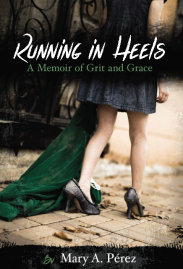
(An excerpt from Running in Heels – A Memoir of Grit and Grace – Chapter One)

© M.A. Perez 2013, All Rights Reserved

Note: I recall many clichés told to me as a kid. One that pops into mind is: Easy come, easy go. How about you? Do you remember things said to you when you were young that maybe got under your skin?

5 Comments

Filed under Memoir, pet

The Little Green Dress

I held her close and cradled her head.

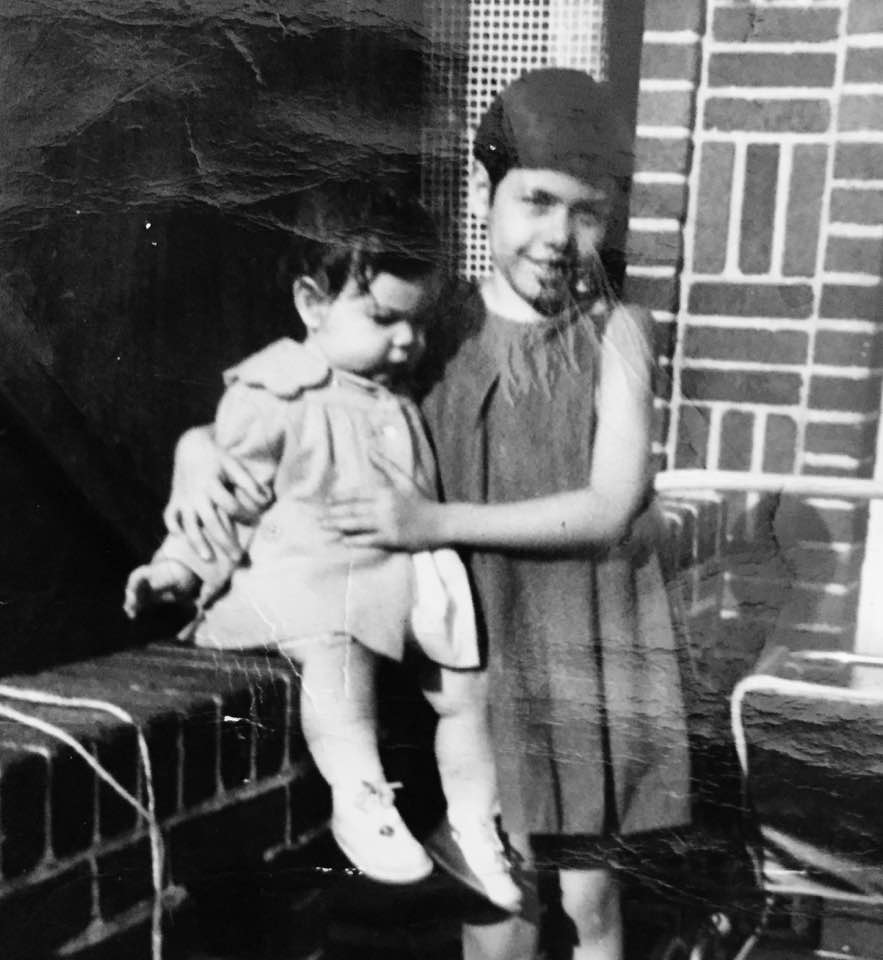
Soft, velvety cheeks. A round, rosy nose. Dark hair like mine, but curly. Eyes, blue, that sparkled like the ocean I’d seen in storybooks. I kissed her sweet-smelling face. Her soft, pudgy hand with tiny fingers curled inside mine. My new baby sister, Anna, melted my heart. I won’t be alone anymore, and she won’t be alone. I caressed her face and whispered, “I’ll stay by your side for always.”

Soon after being left with the responsibility of caring for her, I became my sister’s substitute momma. I loved her and took care of her as best a seven-year-old could.

I didn’t know what to do the day we ran out of baby formula and diapers. I waited until Anna stopped fussing and fell asleep in her carriage (we didn’t have a crib for her). Then I ran to the corner to a hole-in-the-wall, where I knew my mama and stepdad, Jimmy, were.

A blinking neon beer sign over the door clattered when I pushed it open. Dimmed lights hung from the ceiling. The hazy, smoke-filled room from cigarettes made my eyes water and my nose run. Loud music played on the jukebox. Boisterous men and women engaged in a game of shuffleboard; others threw darts. Still others, sloshing their drinks, perched themselves on bar stools, carrying on like screaming peacocks.

“Whataya have?” yelled the bartender. I jumped at his voice, thinking he meant me.

“Hey Charlie, whose girl is this?” a man grinning with a silver tooth asked.

“She’s Ruthie’s little girl,” Charlie answered, pointing in the direction where Mama sat.

The all-too-familiar rowdy voices of my parents, cursing at each other, reached my ears. I ran toward them. When I told Mama about Anna, she and Jimmy started arguing over money.

I waited, feeling forgotten, wishing Mama would hurry and come home with me. Then someone handed me a nickel to play the jukebox. I remembered my manners, thanked him, put my coin in the slot, and punched in the numbers to Spanish Eyes.

At last, Jimmy gave Mama what she wanted, but he remained roosting on his stool.

When we returned home, we never imagined that someone had called the law. They met us at our front door holding my naked sister, wrapped in a soiled blanket.

“Is this your baby?” an officer demanded of Mama.

“Yes . . . yes . . .” her voice cracked.

“Ma’am, have you been drinking?” The other cop asked in a gruff voice. But before Mama answered, he stepped forward and said, “Turn around and put your hands behind your back. You’re under arrest for child abandonment.”

“Ma—?” I choked back the burn in my throat.

To my horror, the police officer put handcuffs on Mama and started telling her something about “remaining silent.”

Why can’t she talk? “Tell him, Mama,” I insisted and started to cry. I turned to the officer to explain, “We were going to buy milk and diapers for my sister . . .”

He didn’t hear me and shoved Mama in his police car. She looked at me; her face glistened with tears running down as they drove away.

“Where . . . is he taking my mama?” I choked, sobbing. I hovered close to Anna, ready to grab my sister, to run fast and hide before he took us to jail, too. In my confusion, I don’t recall what he said except that they were there to help and take us to protective custody. I protect my sister, I thought. I begged him not to separate us.

The cop drove us to a children’s hospital for routine examination and to remain there for safekeeping until a suitable family member claimed us.

(TWO YEARS LATER):

A siren blared nearby.

I turned to Mama and asked, “Where’s Anna?”

“That drunken louse came by to bother me again,” she huffed.

“Mama, you said you were finished with him.”

She swatted the air with her hand as if shooing a mosquito. “He insisted on taking his little girl for a short walk.”

A neighbor came running and whispered breathlessly to Mama. Right then, a police car pulled up, its radio static coming from within. An officer climbed out of his cruiser and walked toward them. Within seconds, someone let out a cry, and her voice sounded familiar. In shock, I witnessed my hysterical Mama sprint down the street. I stifled a scream. My heart pounded in my chest. I didn’t know what happened, where she was going, or why.

I don’t remember who drove us to the hospital. But once we arrived, a nurse pointed down the hall to where they cared for her. Except I couldn’t go to see her because I was too young.

I had to see her.

My legs trembled as I crept to her room and peered through the glass-paned door on my tiptoes. First, I saw a blinking monitor. Then I saw her—my baby sister—with soiled feet, still in her favorite, green denim dress, tattered and torn. On her back, Anna lay motionless, her curly brown hair matted with blood. Her face was bruised and swollen; her baby blues closed tight.

I felt light-headed as I slumped on the floor, pulling my knees to my chest, crying.

That night, we returned to the scene of the accident. I will never forget the puddles of congealed blood that saturated the street. I wanted to scream. To run. To hide. Blood-soaked rags from my sister littered the pavement.

Others offered shallow words of comfort. “Don’t cry,” they said. “Think positive thoughts,” they chimed. “The doctors are doing everything they can for your little sister.” But all I heard was my sister’s blood calling out to me, along with my broken promises: “I’ll protect you,” pounding in my head.

A couple of days after, I awakened to the sound of rain and a car door slamming. I peeped out my window and saw a taxi pulling away from the curb. My grandparents, grim-faced and eyes downcast, walked to our doorstep. A shiver ran down my spine, and a horrible dread washed over me. I threw myself on the bed, a knot lodged in my throat. Then I heard my mother’s wails. I curled up in a ball and covered my ears. God, it hurts! I cried. Make the pain go away.

My sister was gone. Forever. A month earlier, we celebrated her birthday. She had just turned two. I was nine but felt ancient. Empty. And heavy. The weight of the world on my thin shoulders.

Like a fuzzy videotape, fragments of blurred images and sounds played across my mind: Anna’s dancing blue eyes, laughter like the morning sun, vibrant flowers . . . Mama’s primal screams, hushed voices, muffled sobs.

At the funeral, I held my breath and willed my feet toward the small white casket. Grandma squeezed my hand. I took my finger and stroked my sister’s face, which reminded me of a doll made of plastic, stiff and cold to the touch. Heavy make-up could not conceal her bruises. Her grotesque head was cradled by a bonnet that was much too small. She wore a new green dress, cleaned and pressed, with no stains. Or blood.

I glanced up at Grandma. “Your sister’s in a better place now,” she choked. Then I placed a small cross under Anna’s tiny, rigid hands. My tears blinded me.

“. . . If I should die before I wake, I pray thee, Lord, my soul to take.”

Why, God? Why? Why did you have to take her?

Anna, I’ll love you for always.

Mama sat by the farthest wall away from people, away from the coffin. Her eyes were swollen and red. She didn’t seem so tough then. I went to sit by her.

The year 1968 was a year of deaths that shocked and changed history. But the girl in her little green dress was the one who mattered to me. She was my sister. My best friend. She lay in an unmarked grave.

(FOUR DECADES LATER – a flight to Miami):

The area was a lowly, plain grass field devoid of even a tombstone for my sister. No headrest. No name was written. Or flowers anywhere. Just hard soil. Plenty of weeds. I crumbled to my knees and sobbed.

Anna, I’m sorry. Sorry, I couldn’t do better. Sorry, I failed you. I promised, “for always,” yet fell so short. If I could hold you now, I would.

Closer.

Tighter.

Never let you go.

If only I’d done more, fought more, loved more. I see myself holding you. Holding you so tight, that time stands still. Darkness cannot swallow us. Pain cannot touch us. Death cannot rip you from my arms. Sorrow cannot engulf us.

God, it still hurts . . . bring healing.

Before I left the cemetery, my brother and I purchased a tombstone and had it engraved.

Por fin,” I imagined my grandma’s words.

Yes, Grandma, finally,” I whispered. “At last, and long overdue.”

In memory of my sister, Anna R. Molloy, who was struck down by a hit-and-run driver.
© M.A. Perez 2013, All Rights Reserved

37 Comments

September 21, 2013 · 5:50 PM

Faded Roses?

Image

Age. Aging. Ageless.

I rarely think about my age but the body has a way of reminding me whenever I throw my back out or my knee pops. And yes, in the mirror I sometimes notice an extra line here, another wrinkle there, and as I gaze upon certain areas of my physique I find myself wondering, where did “it” go and when did “that” change?

From time to time I muse about my early years in having to grow up so fast, and then in my teens and young adulthood in raising four children. Next thing I knew my twenties were gone, and my marriage was deteriorating. Divorced in my thirties (I felt like a failure but the world did not end), and remarried by my mid-thirties (thank God for new beginnings). I can shout from the rooftop that no marriage is so good that it can’t be made better! (You see, I’ve been married most of my life.) Then when I approached my early forties, the seasons changed again for me, this time, embracing the wonders of grand-parenting.

So, in my fifties, as I reflect on this aging process—knowing I certainly don’t have all the answers—I’ve learned a thing or two about what life has dealt me.

I read in Psalms 90:12: So teach us to number our days, that we may apply our hearts to wisdom.”  This passage speaks to me and tells me to make each day count. I must remember to live in the present, not in the yesterdays or in the tomorrow. I must laugh often, love deeply, pray sincerely, and believe that my best days are before me.

As my birthday quickly approaches the corner, I can’t help but think: have I done all I ever wanted to do? Of course, the answer is a resounding: Not even close. Am I running out of time? That’s God’s business. I believe life is a gift from God and I’ll take each day and cherish the moment. He is the reason for every good thing, every heartbeat, and every second chance.

I love the lyrics to “Every Good Thing” by The Afters:

I tend to be busier than I should be
I tend to think that time is going to wait for me
Sometimes I forget and take for granted
That it’s a beautiful life we live
I don’t want to miss the moments like this
This is a beautiful life You give

You’re the reason for every good thing, every heartbeat
Every day we get to breathe
You’re the reason for anything that lasts, every second chance
Every laugh
Life is so sweet
You’re the reason for every good thing

There will be days that give me more than I can take
But I know that You always make beauty from my heartache
Don’t want to forget or take for granted
That it’s a beautiful life we live
I’m not going to miss the moments like this
This is a beautiful life You give

It’s our family, it’s our friends
It’s the feeling that I get when I see my children smile
You’re the reason for this life, everything we love
It’s You alive in us
You’re alive in us

You are here in every moment, and I know that You’re every good thing
You are here in every moment, and I know that You’re the reason for
You are every good thing

For the love I still see in my children’s eyes, the laughter in my grandchildren’s voices, the warmth of my husband’s embrace, the scent of rain lingering in the air, and the taste of grateful tears streaming down my cheeks, I am thankful for the goodness of God in granting me another year.

Someone said that age is a myth and beauty is a state of mind. I like that.

Faded roses? No. May I grow old gracefully, forever blooming where I am planted, one petal at a time.

A heartfelt thanks to my lovely daughter, Anna, for putting this video together

A heartfelt thanks to my lovely daughter, Anna, for putting this video together


© M.A. Perez, 2013, All Rights Reserved


22 Comments

August 24, 2013 · 9:04 PM

Mi Boricuan Familia

I just returned from an accelerating week’s vacation, which was also a surprise visit to my family in Florida. Other than planning everything with my younger brother, I didn’t want any beans spilled, so I gave no clues and left no hints. My ten-year-old grandson accompanied me; it was his first time on a plane. He was so excited that he never ran out of words the entire flight.IMG_0624[1]

The trip and the family time together were awesome!

My first stop was at my older brother’s. The shock on his face and the familiar choice words that he uttered upon seeing me were priceless. His entire household welcomed me warmly. My three tall nephews are strapping young lads. We all talked at once and managed to hear every word. Soon, my sister-in-law and I enjoyed some overdue and much-needed girl talk alone (after kicking out all the boys).

1092153_158266174363129_1689987005_oThen we drove to my dad’s home, where I was greeted with more1157638_10201825671551316_948345146_n hugs, tears, and kisses. (Click on the link to a video and listen to my daddy’s exclamation phrases over and over: “¡Ay, mi madre!” as well as “¡Ay, Dios mio!”)

Before too long, savory food wafted from the kitchen, calling my name. I couldn’t wait to sample my stepmother’s Puerto Rican cuisine. She did not disappoint and prepared a delicioso feast of pollo frito arroz_con_gandules(fried chicken), plátanos fritos (fried plantains), and arroz con gandules (rice and pigeon peas). 

Mmm hmm, good! ¡Que rico la comida!

IMG_0694[1]My sister later drove into town (also surprising our daddy – yes, it’s in our blood) and soon we were catching up with the latest news over family, food, and fashion. I got to exchange stories with her fine son, amazed by his sharp wit, then observed him and my grandson enjoying one another’s company with the latest video game. Finally, Daddy announced it was time to play dominoes, beating everyone in the game just as I had always remembered.

In the days that followed, we shopped, ate to our heart’s content, spent the day at the beach and the pool, and shared pictures on Facebook (a vast difference from having to pull out dusty album books like the old days). Lastly, we enjoyed taking Daddy to Mai Kai Polynesian Dinner and Show.

I wanted — and needed — to be present to help celebrate my daddy’s 80th birthday that Sunday, and I was grateful to be able to escape my hectic schedule to attend the grand event. If not, I would have been filled with regrets. Now I have wonderful additional memories to hold onto for a lifetime.

With every visit, conversation, and reminiscing, we simply picked up where we left off so long ago. It felt good to be “home” again and reunite with my boricuan familia.

And now you know where I have been this past week.PicMonkey Collage

© M.A. Perez, 2013, All Rights Reserved

10 Comments

August 17, 2013 · 1:39 PM

She Hurts No More

At 5’2”, Grandma was a pleasantly plump woman with a round face and full lips. She had a light olive complexion, and wore reading glasses that sat on a nose “too fat” she often complained. Her soft, wrinkled skin smelled like Jean Naté.

My grandma’s name was Ana, born in 1898, the second of six siblings. She worked as a secretary for a steamship company, typing and transcribing in Gregg’s Shorthand. She was soft-spoken, a temperate woman. I witnessed her faith in action. Seeing her on her knees by the bedside in prayer was the norm. She expressed love and devotion by being a “doer of the Word and not a hearer only,” forever willing to help others. Even during the times when I’d see her wincing from the pain in her knees and feet, she’d still stand over the stove, making treats to hand out, or writing cards and letters to encourage others.

Grandma suffered from arthritis and blamed the tight, pointy shoes she wore in her earlier years for causing her painful feet. All her current black shoes were odd-looking and clunky, like the ones she had worn a long, long time ago. I enjoyed playing in them as a youngster.

Clip-clop. Clip-clop. Grandma’s shoes echoed as I walked in them across the tile floor.

“Mary,” Grandma called to me, sitting at her sewing machine, rubbing her eyes. “You have good eyes, dear. Por favor, thread this needle for me.”

With one eye shut, I squinted, concentrating on the task of getting the string into that tiny hole.

Grandma wanted me to learn how to sew, but I preferred sitting on the floor, playing with her sewing stuff instead. I either sifted through the mason jars she kept filled with buttons of all sizes or rummaged through her large round tin can packed with spools of colorful threads. Inside also were porcelain thimbles, a pincushion, and even a wood-darning egg for sewing Grandpa’s socks.

The click-clacking of her sewing machine in the afternoons was soothing to my ears. Listening to her hum “His Eyes Are on the Sparrow” while she sewed, crocheted, worked in her flowerbed, or bathed me always ushered in a warm sense of belonging and well-being.

On wash days, Grandma ironed all bed sheets, linens, pillowcases, cloth napkins, and even Grandpa’s white hankies. I helped her to fold, but I knew I didn’t like ironing one bit.

“Mary, it’s good that you give me a hand,” Grandma said as she sprinkled water over a napkin before ironing it. “You must learn to do these things yourself one day,” she added.

Gonna get me a maid for that, I thought.  

Overall, I liked helping Grandma with chores. She saved S&H Green Stamps that I enjoyed pasting into a book. She did many things differently from what I saw Mama do with her time. Even when she was busy, Grandma always took the time to talk to me. I liked studying her. I thought it funny the way her mouth moved, with her lips still closed, whenever she read. I marveled at how her fingers typed fast and hard on the keys of her black manual typewriter, wishing I could type like her.

In retrospect, Grandma liked my curious mind and eagerness to learn. When she gave me a small white leather Bible for my own, I felt special.

Mija, have you been studyin’ your Bible verses?”

“Yes, ma’am. I learned it all.”

Bueno, let’s hear it.”

“The Lord is my Shepherd . . .” I began. As promised, when I finished, she gave me a crisp, two-dollar bill.

Sometimes I watched Grandma in the kitchen cooking and helped by peeling carrots or potatoes using her peeler.

“It’s good that you pay attention, dear,” Grandma said, wiping the chicken grease from her hands on her apron.

“Why?” I asked, rubbing my eyes, burning from the onions.

Señoritas must know how to cook. And you dun want to become vaga,” she replied in her broken English, throwing everything into a pot, adding milk.

“What’s vaga?” I asked.

“It means lazy. You dun want to be that; you’ll have a family to care for one day.”

My husband gonna have to help cook if he wants to eat, I mused.

At my grandparents’ house, I’d run about or play hide-and-seek as much as I wanted. Except maybe when I tried playing an April Fool joke.

I waited, crouched down low behind a chair, and listened for her. I thought myself witty and barely could keep from snickering. As her footsteps came closer, timing it just right, I sprang up with arms raised and yelled, “BOO!”

But it so happened that it was my grandpa instead.

He popped my enthusiasm, letting me know it was too early in the morning for such nonsense. He might have popped me on my bottom, too, if he hadn’t missed when I shot past him like a dart and hopped back into bed.

Years later, after Grandpa’s passing away, Grandma hadn’t a soul to depend on. Yet she never stopped doing good deeds for others.

Grandma often spoke with my mama regarding her own illness, insisting she wanted to be at home when it became her time to die and not be in a hospital.

I prayed that when God took Grandma home, He would help me to relinquish her. I didn’t want her to suffer anymore, but still found it difficult to let go. I knew I had to, and I knew I needed to, but I didn’t know how or if I could.

* * *

A horrific day for our country. In shock, I watched the Space Shuttle Challenger break apart and burn, seconds into its flight. Five men and two women lost their lives tragically for the good of all humanity. They lived their dream by serving others. I may not have known them personally, but they died as heroes.

Three months later, on April 3, 1986, sickness reduced an unsung hero to skin and bones as she lost her bout with cancer. She wasn’t affluent. Refined. Or famous. She was an eighty-eight-year-old Puerto Rican woman. My beloved grandma. And my heroine.

When Mama called me and told me about Grandma’s final moments, sobs stuck in my throat. She expressed how she had sat by my grandma’s bedside, terrified while listening to her breathing as it came in short, laborious rasps.

“Your grandma’s parting words were, ‘God is calling me now,’ and then she gazed up at the ceiling,” Mama spoke dolefully. “So, I asked her, ‘How do you know?’ but she didn’t speak anymore. She closed her eyes, and I held her close.”

My mother’s trembling voice jumbled in between her sobs. “I . . . told her that I loved her. And I said to her, ‘you carried me . . . for nine months.’”

I pictured that heart-rending moment, imagining Grandma’s gentle countenance and Mama struggling to convey her love. And I thought, Oh Mama, she carried you longer than nine months. My insides ached, knowing that in her heart and prayers, Grandma carried us all.

My grief came in waves. Looking back, I know God spared me from becoming hopelessly morbid and consumed with anguish. Grandma wouldn’t have wanted that. Knowing she no longer suffered, I believed her final heartbeat didn’t mean the end but the beginning.

I wanted to celebrate her life when I journeyed back to help with her memorial.

Once a plump woman, Grandma had lost so much weight in her final days. She had always loved a white Easter dress of mine and requested that we bury her in it. My dress fit her perfectly then. I also asked that everyone wear white instead of the customary black garments at her funeral.

White carnations—Grandma’s favorite flowers—covered her open casket. I stood, my eyes caressing her still face, now so thin. Vivid images of her life jumped into my thoughts. I saw her on her knees pleading with God to be merciful to her loved ones. I recalled the many prayers she offered in gratitude for another day. I pictured her lips moving wordlessly when she read her Bible, with her index finger pointing to the sentences across the worn-out pages. I could still hear the sound of her soft voice calling my name. I remembered the merriment of her laughter after listening to one of my silly jokes. I couldn’t blink away the hot tears that blinded me.

In my mind’s eye, Grandma came to me.

I could hear her.

Feel her.Grandma

Touch her.

Her love, her hugs, and her kisses embraced me.

We honored her memory and her passing from this life into the next.

A gentle breeze blew away the heat of the day; the sun hid behind the clouds. The scent of rain.

As it started to drizzle, my heart was comforted. Grandma always considered it a good omen if it rained on the day someone was laid to rest.

Before long, her coffin lay in a crypt next to her cherished husband, my grandpa.

At last, Grandma’s labors had ended. Thank God, she hurt no more.

(An excerpt from Running in Heels – A Memoir of Grit and Grace. A small tribute to my dear grandma, who passed away 27 years ago, whose birthday would have been this month.)

© M.A. Perez, 2013, All Rights Reserved

13 Comments

Filed under Crossing Over, death, the Challenger

Metamorphosis

My family was poor. As a child, without having four-legged friends, I developed an unusual fascination with the behaviors of tiny critters, mainly insects. Curious about what lay beneath the ant piles, I liked to dig apart their colonies to watch the different activities of the workers, the soldiers, and the queen ant that I read about in library books. I never developed a fear of grasshoppers, even if they spat “tobacco” on my fingers, or of handling caterpillars that pricked when they crawled on my hand, or of sneaking up on lizards that left their wiggling tails behind, wondering what the funny red thing on their throats going in and out was all about. My fascination with those critters was a favorite pastime.

Not all school projects were memorable, but I remember one that stuck with me for years. When the teacher assigned a report on any subject, I decided to pick caterpillars. On a large poster board, I drew the four stages of the butterfly: (1) egg, (2) larva, (3) pupa, and (4) adult. I described metamorphosis. Though it wasn’t a Picasso, my work earned a ranking on my school’s hallway wall, posted for all to see, with the highest mark in class: A+.

One sunny day at recess, I found a black woolly caterpillar crawling in the shrubs and gently placed it in my palm. My classmate was naturally curious and asked to see what I held. When I opened my hand to show him, he whacked it so hard that the caterpillar flew out and disappeared into a bush. And that’s when I morphed! Without hesitation, I slapped him on the face, hard. The boy stood stunned, mouth open.

As an adult, I often thought about the word metamorphose. It means to change completely in nature or form.

I think about how alcohol deceived my loved ones, giving them a false sense of reality. After drinking, like the caterpillar many years ago in my book report, they metamorphosed into social butterflies fresh out of their cocoon. They felt invincible, glamorous, or intelligent. Gone were the restraints that crippled them emotionally. They carried a false sense of bravado. It was then that they laughed wildly, conversed freely, and flirted openly.

The more attention and compliments they received from others, the less they knew the difference between genuine praise and mere flattery.

(A small excerpt from Running in Heels – A Memoir of Grit and Grace ).

© M.A. Perez, 2013, All Rights Reserved

12 Comments

June 26, 2013 · 10:20 PM

Amazing Grace

I kissed her sweet, velvety cheeks. When her tiny hand wrapped around my finger, she instantly wrapped around my heart. Having just witnessed the birth of my first granddaughter, I was simply ecstatic. Grace Elizabeth, a little thing with a mop of chestnut hair and raven eyes, reminded me of the sister I had lost so long ago.

Not long after, our joy was short-lived. Apprehension and a staggering wave of fear suddenly replaced excitement and joy.

Her doctor ordered x-rays, ultrasounds, RSV, EKG, blood work, and an echocardiogram. “She has three holes in her heart,” he announced. His foreign words invaded my head: “congenital heart defect . . . coarctation of the aorta . . . a ventricular septal defect . . . an arterial septal defect . . . a bicuspid aortic
valve . . .”

But three words snatched my breath away: “Open-heart surgery.”

Surrounded by family, we waited. Watched. And prayed.

That night, my daughter, Angela, and I shared a couch that converted into a bed in Grace’s room. Dreams and visions overlapped, as I drifted in and out of a fitful slumber. Nurses routinely came in to check on Grace’s vital signs, administered meds, and prepared her feeding tube around the clock, interrupting sleep.

But tonight was different. At 3 a.m., a nurse instructed all residents to remain in their rooms, keeping the doors closed. We couldn’t help but peek out of the window blinds. We watched in horror as the mother of the infant in Room 1704 ran inside, her hand over her mouth. Her wails carried across the hallway from inside. When other relatives arrived, they held onto one another, weeping, lamenting, and grieving.

Tears flowed down our faces. I gazed upon Angela—my baby girl who always wanted a baby girl—and grieved along with her. Though she carried unspoken heaviness, she remained strong for her household.

My eyes fixate upon our sick Grace. The doctors had said that Grace needed to gain weight, but she only grew weaker and tired more easily. Instead of eating, she slept during feedings. I watched her shallow, rapid breathing and listened to the heart monitor. Beep. A precious life. Beep. Hopelessness loomed. Beep. I said another prayer.

Beep, Beep, Beep. The rhythm of Grace’s heart monitor echoed louder in my head.

Come morning, more alarming reports:

“Murmur is louder.”

“Heart’s beating fast; enlarged, working too hard.”

“Surgery tomorrow.”

We waited for the day; we waited for the hour, but when the time for her procedure arrived, tomorrow seemed much too soon!

In the morning, we huddled around Grace in a curtained room. Words failed to express our love for this precious twenty-nine-day-old child. We covered her with our tears, our kisses, and our prayers.

“Please, Lord, bring her back to me,” my daughter whispered, crying.

In a moment, they whisked her away to prep her and lay her on the operating table, surrounded by nine surgeons. We felt helpless but believed God while we prayed that He would return Grace to us alive . . . whole . . . and healthy.

After four hours in surgery, the cardiologist reported, “Grace’s heart is very sick,” and added, “We didn’t know how sick until actually seeing it.”

The pendulum swung. We sat and paced. Paced and sat.

A flood of questions crammed my mind: How do you silence the sobs that overtake you? How can you calm the waters and keep the dam from bursting from within the depths of your being? How do you say goodbye when someone has captured your very heart and soul?

Nine hours later, we were told, “Her heart failed when taken off bypass.”

My gut tightened. “Please, Lord.”

We gathered in a quiet room to pray. I studied the faces of each family member. The women prayed openly as they cried out to God. The men, unable to trust their voices, kept their mouths shut for fear of losing control.

After three hours, the doctor’s assistant entered and announced, “She’s made it, but she’s not out of the woods yet.”

We hugged one another. Tears of relief flow freely.

“The next forty-eight hours will be critical,” she cautioned. “You can briefly see her soon.”

Emotions ran raw; I lacked the courage to see Grace lying still, motionless, and heavily sedated. “I want to see my granddaughter when her beautiful eyes are open,” I said.

Angela understood. “Mom, go home and rest,” she urged. “I’ll keep you posted.”

Day One Post-Surgery, my daughter’s report via email:

Baby Grace remains heavily sedated and has countless tubes and wires attached to her tiny frame. Mom, the list is endless: a breathing tube, a pacemaker, a rectal thermometer, a catheter, and so much more. Arms and inner thighs are bruised due to multiple attempts to locate the main artery. The sides of her head are shaven. Her face is bloated from fluids. One lung has collapsed. Mom, I’m so scared!

Day Two Post-Surgery, another email:

No movement, still heavily sedated. I held Baby Grace’s little hand and said, “Mommy’s here.” Grace moved her head for me, and I whispered in her ear, “Mommy loves you so much.” When her eyes opened for me, my heart skipped a beat!

Day Three Post-Surgery:

Mom, Grace is better and responding to touch. Her swelling has gone down. They reinstalled her feeding tube today and are giving me 5cc of my breast milk per hour. She is eating now and will gain weight again.

Day Five:

My first day seeing Grace since her surgery. Overflows of emotions bombarded every nerve in my being. Hope crashed into fear. Joy into anxiety.

I must keep it together. My legs turned to putty. My daughter took me by the hand and led me into Grace’s room . . .

I see her! I reached down, caressed her face, and gently placed my hand over her chest. The incision was the length of my index finger.

And then her eyes! Those familiar eyes sparkled and looked at me as if to say, “See Mimi. I’m here. I’ve made it.”2062_1069678230028_1130_n

Seven years have passed.

Grace recently graduated to the first grade, grinning from ear to ear. She laughs and skips about, discovering her world. My precious granddaughter has been through so much. She won’t remember a thing about her ordeal. Nevertheless, I will forever hold onto the memories of those dark days and long nights. I will relish the story of this tiny girl who showed tenacity and never gave up.

I lift Grace, embrace her, and smother her with kisses. Her little heart beats next to mine; nothing short of a miracle.

Our hope.942275_10201220822310463_1048247074_n
Our joy.
Our gift.
Amazing Grace.

© M.A. Perez, 2013, All Rights Reserved

8 Comments

Filed under 29-days old, Grace, Health, Open-heart surgery

Confession of a Daughter

I’m jealous.

I confess.

I don’t think I ever grasped this concept until now. It pains me to admit this, but it’s true. Whenever I hear others express the close bond that they have with their mothers, I marvel at how grand that must be!

And it stings.

Mama used to say: “You can have ten fathers but only one mother.”

I heard that line growing up and believed it. After my parents divorced, I had three different step-dads. I didn’t want to share my mama; she wasn’t married to any of them. I wanted us to be by ourselves. But Mama was too busy for me. I’m sure she did the best she could, but nurturing wasn’t in her DNA. Left on my own a great deal, I was a neglected child.

Loneliness was my middle name.

At the age of nine, after we moved to Florida, my grandma became more like a mother to me. I knew then what a mother’s love felt like, and it just wasn’t the same as Mama’s. Oh, to be sure, I love my mama; she gave birth to me. But because I had no choice but to grow up too fast, our roles had always been reversed.  Most of the time, I felt like I was the mother. I wasn’t a model teenager either, and couldn’t wait to leave home in search of love.

The miles separate, the years have passed, and Mama and I have both aged. I look back and forgive my past; it has made me who I am today. I’ve had to learn to forgive my mama a hundred times over, whose harshness and demeanor become more passive and feeble with time. She’s not perfect. And neither am I.

I am a mother now. And I pray that my own children will always feel my love.

No matter what.

It takes work. Prayer.

And much forgiveness.

Our communication skills still have room for improvement. I’ll keep working on it.

Mother’s Day is around the corner. It has always been so complicated for me to choose the right Mother’s Day card. Maybe this time I won’t have to keep putting the cards back on the shelf in search of the one that describes Mama perfectly.

Maybe, I’ll write one for her myself:

To my one and only Mama.Me and Mom

I loved you then.

I love you now.

No matter what.

Love always, your little girl.
© M.A. Perez, 2013, All Rights Reserved

7 Comments

May 2, 2013 · 9:56 PM

For Keeps

ImageToday is our anniversary.

Nineteen years ago, I said “I do” to the most loving and gentle man I know.

And I’m so glad I did.

He came into my world when I was a desperate, single mother of four: ages nine, eleven, twelve, and fourteen. He not only loved me then, but he loved and embraced my children. And they loved him back.

Today, as I fixate on my husband’s face—his eyes weathered by deep trenches of experience, his hair and beard more gray than brown—a sense of contentment warms me. His gaze still carries the familiar twinkle. They speak of tenderness, honesty, and devotion. His eyes say I am a star in his galaxy, and that he will remain by my side through thick and thin. They confirm that together we are one. Moreover, those eyes proclaim that with God, we can weather any storm.

I hadn’t always known this gentleness and steadfastness in a mate. But this one was my second chance at love and happiness, assuring me that my mate and true friend accepts me unconditionally and without reservation. He loves me on my worst days. He loves me on my best days. I don’t feel alone if he’s away.

Yes, we have faced scores of satisfactions and disappointments, victories and losses, accomplishments and failures, heartaches and joys. Some we understand. Some we don’t. But God gives us grace and peace that exceeds our comprehension.

And life moves on.

© M.A. Perez, 2013, All Rights Reserved

“He’s not perfect. You aren’t either, and the two of you will never be perfect. But if he can make you laugh at least once, causes you to think twice, and if he admits to being human and making mistakes, hold onto him and give him the most you can. He isn’t going to quote poetry, he’s not thinking about you every moment, but he will give you a part of him that he knows you could break. Don’t hurt him, don’t change him, and don’t expect more than he can give. Don’t analyze. Smile when he makes you happy, yell when he makes you mad, and miss him when he’s not there. Love is hard when there is love to be had. Because perfect guys don’t exist, but there’s always one guy that is perfect for you.”
~ Bob Marley

6 Comments

Filed under Personal, Wedding Anniversary