Tag Archives: personal

The Little Green Dress

I held her close and cradled her head.

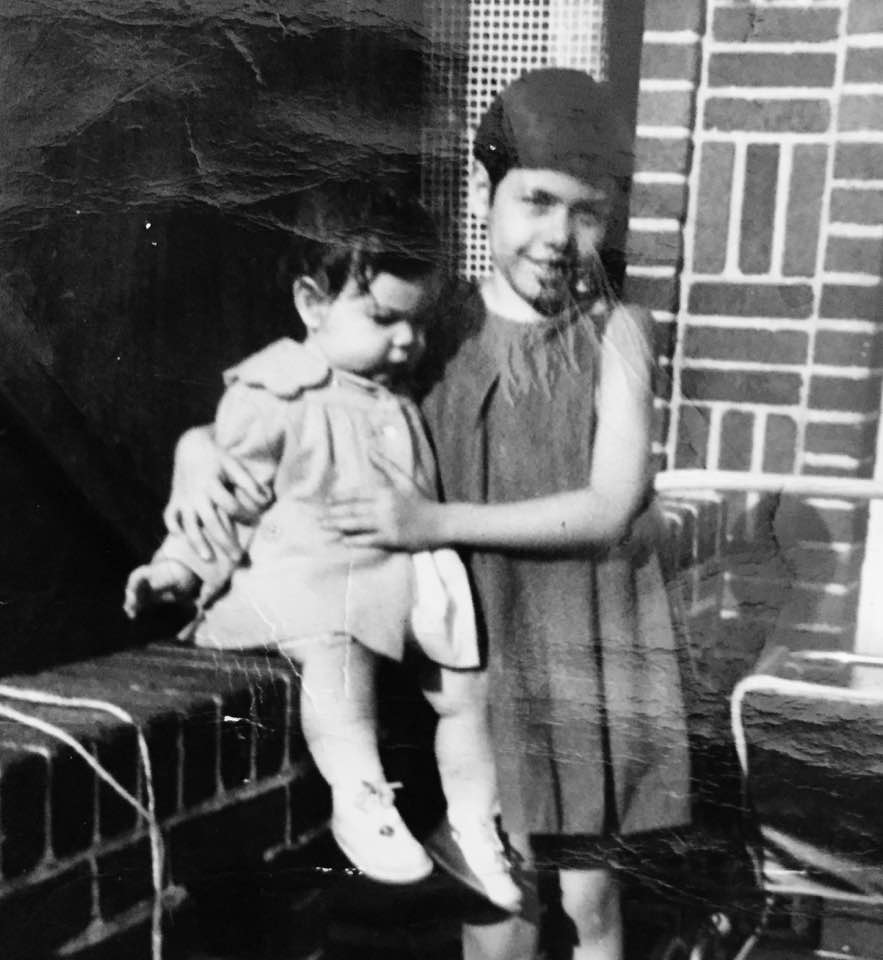
Soft, velvety cheeks. A round, rosy nose. Dark hair like mine, but curly. Eyes, blue, that sparkled like the ocean I’d seen in storybooks. I kissed her sweet-smelling face. Her soft, pudgy hand with tiny fingers curled inside mine. My new baby sister, Anna, melted my heart. I won’t be alone anymore, and she won’t be alone. I caressed her face and whispered, “I’ll stay by your side for always.”

Soon after being left with the responsibility of caring for her, I became my sister’s substitute momma. I loved her and took care of her as best a seven-year-old could.

I didn’t know what to do the day we ran out of baby formula and diapers. I waited until Anna stopped fussing and fell asleep in her carriage (we didn’t have a crib for her). Then I ran to the corner to a hole-in-the-wall, where I knew my mama and stepdad, Jimmy, were.

A blinking neon beer sign over the door clattered when I pushed it open. Dimmed lights hung from the ceiling. The hazy, smoke-filled room from cigarettes made my eyes water and my nose run. Loud music played on the jukebox. Boisterous men and women engaged in a game of shuffleboard; others threw darts. Still others, sloshing their drinks, perched themselves on bar stools, carrying on like screaming peacocks.

“Whataya have?” yelled the bartender. I jumped at his voice, thinking he meant me.

“Hey Charlie, whose girl is this?” a man grinning with a silver tooth asked.

“She’s Ruthie’s little girl,” Charlie answered, pointing in the direction where Mama sat.

The all-too-familiar rowdy voices of my parents, cursing at each other, reached my ears. I ran toward them. When I told Mama about Anna, she and Jimmy started arguing over money.

I waited, feeling forgotten, wishing Mama would hurry and come home with me. Then someone handed me a nickel to play the jukebox. I remembered my manners, thanked him, put my coin in the slot, and punched in the numbers to Spanish Eyes.

At last, Jimmy gave Mama what she wanted, but he remained roosting on his stool.

When we returned home, we never imagined that someone had called the law. They met us at our front door holding my naked sister, wrapped in a soiled blanket.

“Is this your baby?” an officer demanded of Mama.

“Yes . . . yes . . .” her voice cracked.

“Ma’am, have you been drinking?” The other cop asked in a gruff voice. But before Mama answered, he stepped forward and said, “Turn around and put your hands behind your back. You’re under arrest for child abandonment.”

“Ma—?” I choked back the burn in my throat.

To my horror, the police officer put handcuffs on Mama and started telling her something about “remaining silent.”

Why can’t she talk? “Tell him, Mama,” I insisted and started to cry. I turned to the officer to explain, “We were going to buy milk and diapers for my sister . . .”

He didn’t hear me and shoved Mama in his police car. She looked at me; her face glistened with tears running down as they drove away.

“Where . . . is he taking my mama?” I choked, sobbing. I hovered close to Anna, ready to grab my sister, to run fast and hide before he took us to jail, too. In my confusion, I don’t recall what he said except that they were there to help and take us to protective custody. I protect my sister, I thought. I begged him not to separate us.

The cop drove us to a children’s hospital for routine examination and to remain there for safekeeping until a suitable family member claimed us.

(TWO YEARS LATER):

A siren blared nearby.

I turned to Mama and asked, “Where’s Anna?”

“That drunken louse came by to bother me again,” she huffed.

“Mama, you said you were finished with him.”

She swatted the air with her hand as if shooing a mosquito. “He insisted on taking his little girl for a short walk.”

A neighbor came running and whispered breathlessly to Mama. Right then, a police car pulled up, its radio static coming from within. An officer climbed out of his cruiser and walked toward them. Within seconds, someone let out a cry, and her voice sounded familiar. In shock, I witnessed my hysterical Mama sprint down the street. I stifled a scream. My heart pounded in my chest. I didn’t know what happened, where she was going, or why.

I don’t remember who drove us to the hospital. But once we arrived, a nurse pointed down the hall to where they cared for her. Except I couldn’t go to see her because I was too young.

I had to see her.

My legs trembled as I crept to her room and peered through the glass-paned door on my tiptoes. First, I saw a blinking monitor. Then I saw her—my baby sister—with soiled feet, still in her favorite, green denim dress, tattered and torn. On her back, Anna lay motionless, her curly brown hair matted with blood. Her face was bruised and swollen; her baby blues closed tight.

I felt light-headed as I slumped on the floor, pulling my knees to my chest, crying.

That night, we returned to the scene of the accident. I will never forget the puddles of congealed blood that saturated the street. I wanted to scream. To run. To hide. Blood-soaked rags from my sister littered the pavement.

Others offered shallow words of comfort. “Don’t cry,” they said. “Think positive thoughts,” they chimed. “The doctors are doing everything they can for your little sister.” But all I heard was my sister’s blood calling out to me, along with my broken promises: “I’ll protect you,” pounding in my head.

A couple of days after, I awakened to the sound of rain and a car door slamming. I peeped out my window and saw a taxi pulling away from the curb. My grandparents, grim-faced and eyes downcast, walked to our doorstep. A shiver ran down my spine, and a horrible dread washed over me. I threw myself on the bed, a knot lodged in my throat. Then I heard my mother’s wails. I curled up in a ball and covered my ears. God, it hurts! I cried. Make the pain go away.

My sister was gone. Forever. A month earlier, we celebrated her birthday. She had just turned two. I was nine but felt ancient. Empty. And heavy. The weight of the world on my thin shoulders.

Like a fuzzy videotape, fragments of blurred images and sounds played across my mind: Anna’s dancing blue eyes, laughter like the morning sun, vibrant flowers . . . Mama’s primal screams, hushed voices, muffled sobs.

At the funeral, I held my breath and willed my feet toward the small white casket. Grandma squeezed my hand. I took my finger and stroked my sister’s face, which reminded me of a doll made of plastic, stiff and cold to the touch. Heavy make-up could not conceal her bruises. Her grotesque head was cradled by a bonnet that was much too small. She wore a new green dress, cleaned and pressed, with no stains. Or blood.

I glanced up at Grandma. “Your sister’s in a better place now,” she choked. Then I placed a small cross under Anna’s tiny, rigid hands. My tears blinded me.

“. . . If I should die before I wake, I pray thee, Lord, my soul to take.”

Why, God? Why? Why did you have to take her?

Anna, I’ll love you for always.

Mama sat by the farthest wall away from people, away from the coffin. Her eyes were swollen and red. She didn’t seem so tough then. I went to sit by her.

The year 1968 was a year of deaths that shocked and changed history. But the girl in her little green dress was the one who mattered to me. She was my sister. My best friend. She lay in an unmarked grave.

(FOUR DECADES LATER – a flight to Miami):

The area was a lowly, plain grass field devoid of even a tombstone for my sister. No headrest. No name was written. Or flowers anywhere. Just hard soil. Plenty of weeds. I crumbled to my knees and sobbed.

Anna, I’m sorry. Sorry, I couldn’t do better. Sorry, I failed you. I promised, “for always,” yet fell so short. If I could hold you now, I would.

Closer.

Tighter.

Never let you go.

If only I’d done more, fought more, loved more. I see myself holding you. Holding you so tight, that time stands still. Darkness cannot swallow us. Pain cannot touch us. Death cannot rip you from my arms. Sorrow cannot engulf us.

God, it still hurts . . . bring healing.

Before I left the cemetery, my brother and I purchased a tombstone and had it engraved.

Por fin,” I imagined my grandma’s words.

Yes, Grandma, finally,” I whispered. “At last, and long overdue.”

In memory of my sister, Anna R. Molloy, who was struck down by a hit-and-run driver.
© M.A. Perez 2013, All Rights Reserved

37 Comments

September 21, 2013 · 5:50 PM

Faded Roses?

Image

Age. Aging. Ageless.

I rarely think about my age but the body has a way of reminding me whenever I throw my back out or my knee pops. And yes, in the mirror I sometimes notice an extra line here, another wrinkle there, and as I gaze upon certain areas of my physique I find myself wondering, where did “it” go and when did “that” change?

From time to time I muse about my early years in having to grow up so fast, and then in my teens and young adulthood in raising four children. Next thing I knew my twenties were gone, and my marriage was deteriorating. Divorced in my thirties (I felt like a failure but the world did not end), and remarried by my mid-thirties (thank God for new beginnings). I can shout from the rooftop that no marriage is so good that it can’t be made better! (You see, I’ve been married most of my life.) Then when I approached my early forties, the seasons changed again for me, this time, embracing the wonders of grand-parenting.

So, in my fifties, as I reflect on this aging process—knowing I certainly don’t have all the answers—I’ve learned a thing or two about what life has dealt me.

I read in Psalms 90:12: So teach us to number our days, that we may apply our hearts to wisdom.”  This passage speaks to me and tells me to make each day count. I must remember to live in the present, not in the yesterdays or in the tomorrow. I must laugh often, love deeply, pray sincerely, and believe that my best days are before me.

As my birthday quickly approaches the corner, I can’t help but think: have I done all I ever wanted to do? Of course, the answer is a resounding: Not even close. Am I running out of time? That’s God’s business. I believe life is a gift from God and I’ll take each day and cherish the moment. He is the reason for every good thing, every heartbeat, and every second chance.

I love the lyrics to “Every Good Thing” by The Afters:

I tend to be busier than I should be
I tend to think that time is going to wait for me
Sometimes I forget and take for granted
That it’s a beautiful life we live
I don’t want to miss the moments like this
This is a beautiful life You give

You’re the reason for every good thing, every heartbeat
Every day we get to breathe
You’re the reason for anything that lasts, every second chance
Every laugh
Life is so sweet
You’re the reason for every good thing

There will be days that give me more than I can take
But I know that You always make beauty from my heartache
Don’t want to forget or take for granted
That it’s a beautiful life we live
I’m not going to miss the moments like this
This is a beautiful life You give

It’s our family, it’s our friends
It’s the feeling that I get when I see my children smile
You’re the reason for this life, everything we love
It’s You alive in us
You’re alive in us

You are here in every moment, and I know that You’re every good thing
You are here in every moment, and I know that You’re the reason for
You are every good thing

For the love I still see in my children’s eyes, the laughter in my grandchildren’s voices, the warmth of my husband’s embrace, the scent of rain lingering in the air, and the taste of grateful tears streaming down my cheeks, I am thankful for the goodness of God in granting me another year.

Someone said that age is a myth and beauty is a state of mind. I like that.

Faded roses? No. May I grow old gracefully, forever blooming where I am planted, one petal at a time.

A heartfelt thanks to my lovely daughter, Anna, for putting this video together

A heartfelt thanks to my lovely daughter, Anna, for putting this video together


© M.A. Perez, 2013, All Rights Reserved


22 Comments

August 24, 2013 · 9:04 PM

“God, I’m drowning!”

One hot, sticky summer afternoon we thrill-seekers strolled along Haulover Pier. The boys horsed around and dared one another to hop into the ocean, some ten or fifteen feet below. Not only was I skittish about heights, I never learned to swim.No Swimming

The boys jumped in one by one, hooting and hollering, and the girls followed. The one rule: Whoever dawdled was shoved over the side. For the benefit of all who considered me fair game, I gave all nearby a fair warning at the top of my lungs, “I Can’t Swim! Don’t Even Think About It!”

The words were no sooner out of my mouth than a prankster shoved me over the edge. I careened into thin air and plummeted into the waters below. The deep, turquoise ocean slammed onto my face and chest, and the air sucked right out of me. A solitary thought came to mind as I sank into the murky depths:

Not this, again! 

I was seven years old when my new friend, Gina, and her mom invited me to a public pool. Gina’s mom wore headbands and tie-dyed psychedelic T-shirts. Mama had labeled her a “free-spirited hippie.” I thought she knew how to have fun.

Not used to being in the water, I lay contentedly on my stomach along the edge of the pool, watching the others dive and swim.

Behind me, the hushed voice of Gina’s mom urged her to do something. How I envied Gina. She had a mother who encouraged her, one who enjoyed the pool instead of staying out all night and sleeping during the day.

“Go on.” I heard Gina’s mom say, closer now.

Suddenly, thud! Someone shoved me over the edge.

Splash! The cold water slapped me.

The water smacked my face and swallowed me. My mouth and my eyes popped open. I saw underwater for the first time. My nose burned from the chlorine. I pushed and pulled to get air, get air!

I surfaced and tried to gasp out the word help, but water filled my mouth.

A man jumped in and pushed me toward the shallow end. I barely had the strength to hold onto the rail and reach the steps. Weak and trembling from the cold, I grabbed my towel and wrapped it around me.

Gina’s face turned pale, and her eyes gawked wide with terror. I plopped down on a chair, too stunned to move, too ashamed to speak. Then I heard Gina’s mom say, “I can’t believe she couldn’t swim.”

Six years later, I still couldn’t.

As I floundered toward the surface, my eyes were burning; my throat was raw. When my mouth opened, I gulped more seawater.

Choking!

I couldn’t catch my breath.

God, I’m drowning! Help me!

My lungs screamed for air. My muscles burned. I felt like lead.

So weak . . .

The current swept me farther from shore.

Too far . . .

Suddenly, a pair of hands reached for me. I saw arms. I clawed at them desperately, wildly climbing over the shoulders and heads of anyone brave enough to come near. I nearly drowned my rescuers. After an eternity, someone pulled me until I reached shallow water.

With what strength left, I paddled to shore and collapsed on the beach. The others followed and dropped next to me. Their expressions showed concern.

“That . . . that was close,” Earl croaked, coughing up mucus.

“Yeah,” his brother, John, chimed in. “We thought you were a goner for sure.”

“Man. You nearly took us down with you!” Sandra choked.

“I told you!” I grumbled. “I told you all I couldn’t swim.”

“Man, we didn’t believe you really couldn’t.”

I hated being afraid and feeling out of control.

Determined to overcome my fear of drowning, several months later, I learned to float and dive off the diving board. Although I was never a strong swimmer, I enjoyed participating in underwater swimming races.

I conquered that fear.

(After having a couple of near-drowning incidents – one as a youngster and one in my teens – I’m thankful for God looking out for me and giving me a way of escape. Later in life, I took swimming lessons with my own kiddos.)

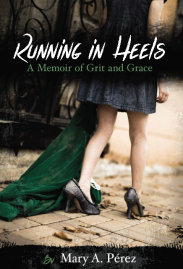
An excerpt from Running in Heels – A Memoir of Grit and Grace

© M.A. Perez, 2013, All Rights Reserved

6 Comments

Filed under Drowning, teenagers

Confession of a Daughter

I’m jealous.

I confess.

I don’t think I ever grasped this concept until now. It pains me to admit this, but it’s true. Whenever I hear others express the close bond that they have with their mothers, I marvel at how grand that must be!

And it stings.

Mama used to say: “You can have ten fathers but only one mother.”

I heard that line growing up and believed it. After my parents divorced, I had three different step-dads. I didn’t want to share my mama; she wasn’t married to any of them. I wanted us to be by ourselves. But Mama was too busy for me. I’m sure she did the best she could, but nurturing wasn’t in her DNA. Left on my own a great deal, I was a neglected child.

Loneliness was my middle name.

At the age of nine, after we moved to Florida, my grandma became more like a mother to me. I knew then what a mother’s love felt like, and it just wasn’t the same as Mama’s. Oh, to be sure, I love my mama; she gave birth to me. But because I had no choice but to grow up too fast, our roles had always been reversed.  Most of the time, I felt like I was the mother. I wasn’t a model teenager either, and couldn’t wait to leave home in search of love.

The miles separate, the years have passed, and Mama and I have both aged. I look back and forgive my past; it has made me who I am today. I’ve had to learn to forgive my mama a hundred times over, whose harshness and demeanor become more passive and feeble with time. She’s not perfect. And neither am I.

I am a mother now. And I pray that my own children will always feel my love.

No matter what.

It takes work. Prayer.

And much forgiveness.

Our communication skills still have room for improvement. I’ll keep working on it.

Mother’s Day is around the corner. It has always been so complicated for me to choose the right Mother’s Day card. Maybe this time I won’t have to keep putting the cards back on the shelf in search of the one that describes Mama perfectly.

Maybe, I’ll write one for her myself:

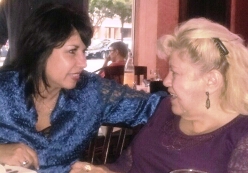
To my one and only Mama.Me and Mom

I loved you then.

I love you now.

No matter what.

Love always, your little girl.
© M.A. Perez, 2013, All Rights Reserved

7 Comments

May 2, 2013 · 9:56 PM